Power = offensive / aggressive
Distance = Even longer / greater range
Accuracy = Even more precise
This is a concept typical of Graphiteleader.
A fishing rod must be superior in strength. Just as important is a tough, enduring power that does not yield to the target fish. It should be light and very easy to handle while hiding immeasurable power inside. Only then – we are convinced – can you take the initiative with confidence during the fight.
With lure rods, casting performance is also required so that large areas can be searched effectively. And it is not just about casting far: what matters is distance performance with accuracy, i.e. the ability to place the lure even more precisely on the targeted spot. Only when Power, Distance and Accuracy come together in a balanced ratio can one speak of an outstanding rod.
The PDAS theory changes golf
Similar to lure rods, we believe the requirements for a golf shaft are made up of P (Power), D (Distance), A (Accuracy) and S (Sensitivity/feel). By balancing these four elements, Graphiteleader shafts achieve a shaft design that suits all golfers optimally.

Tougher / more durable blanks, even lighter and more agile handling and an even stronger “feedback” high-sensitivity behaviour. Providing blanks that are optimally matched to the performance required in real fishing is exactly why Graphiteleader is regarded as a leader.

■ By weaving in carbon fibres that are crossed and aligned in direction, the uniformity of laminate density and orientation stability are increased compared to woven fabric. Since the material is also formed with greater wall thickness, it shows even better resistance to bending, torsion and compressive load.
As a result, the recovery speed of the blanks (shape-restoring force) is high, so energy losses could be reduced to a minimum. This enables a distinct “snap/rebound” feel, better follow-through, more casting distance and higher accuracy.

■ This 4-axis braid is a special 4-axis braid developed by Olympic itself. By inclining the angle of the diagonally arranged fibres up to and building the braid with higher density, blanks can be made that are light and at the same time convey a distinct feeling of stiffness.
Through a multiaxial structure created by combining with other 4-axis braids or plain-weave carbon, even higher blank performance can be achieved.

■ SUPER QUATTRO GRAPHITE CLOTH LV is the lightest 4-axis braid. Without impairing the kinetic-energy effect of the 0°/90°/45° fibres, a weight reduction of was achieved. It shows its strengths especially where even more consistent weight saving is required, or in small-diameter applications.


Even more consistently focused on higher-quality materials.


Torayca® M46X
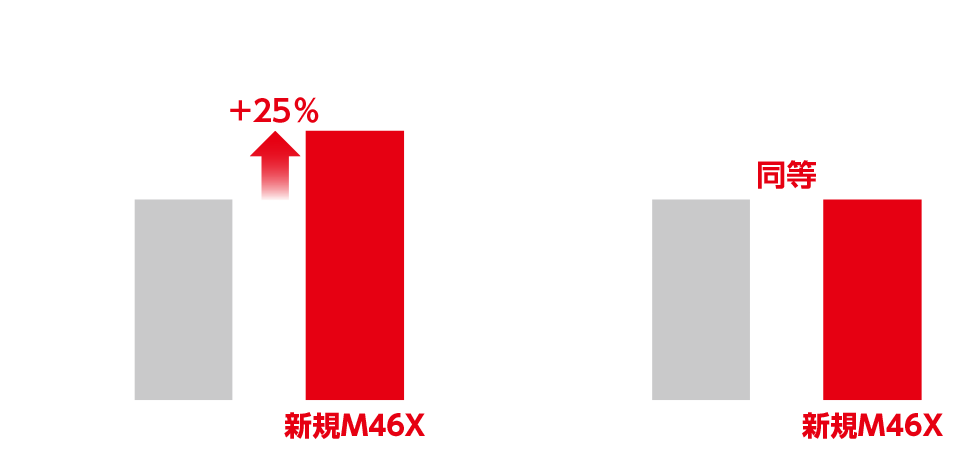

Torayca® M40X


Torayca® T1100G


Torayca® T700G
“TORAYCA® T700G”: the fibre properties are slightly superior in elasticity compared to T700S. By combining (compounding) it with Nanoalloy resin, the basic performance characteristics are raised a level above conventional products.
“Nanoalloy®” – an innovative technology for controlling fine structure (microstructure).

Nanoalloy® technology
Toray Industries, Inc.’s “Nanoalloy® technology” is an innovative technology that achieves in resins an effect long considered contradictory and hard to reconcile: while toughness is retained, the elastic modulus is increased at the same time.



Technology for the further development of carbon-fibre-reinforced plastic (CFRP)
“Namd™” (Enuamudo)
We use the new “Namd™” technology from Nitta Corporation with which nano-dispersed carbon nanotubes (CNT) can be uniformly incorporated into carbon fibres.
These are special carbon fibres in which CNT adhere uniformly to the “TORAYCA” carbon fibres of Toray Industries, Inc. (our main raw material supplier). They are aligned uniformly, processed into prepreg sheets and then laminated (built up in layers) in our products.
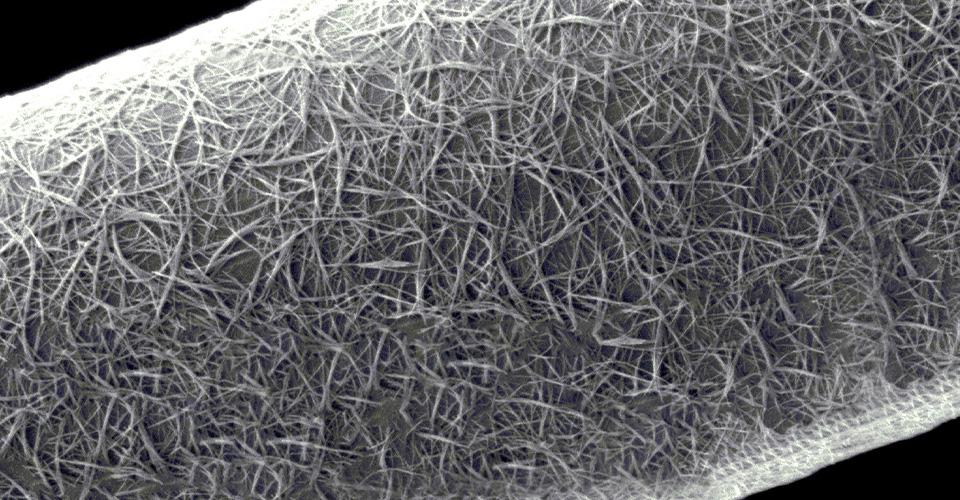
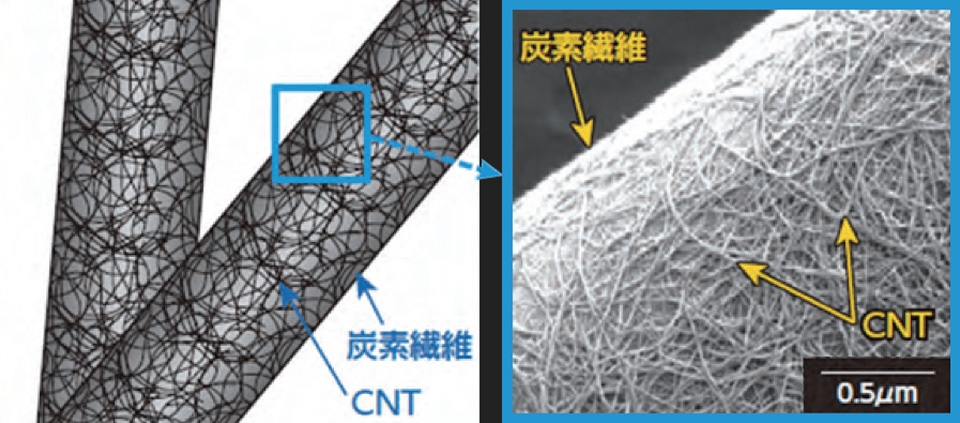
■ Comparison of “normal CFRP” and “Namd™ CFRP”
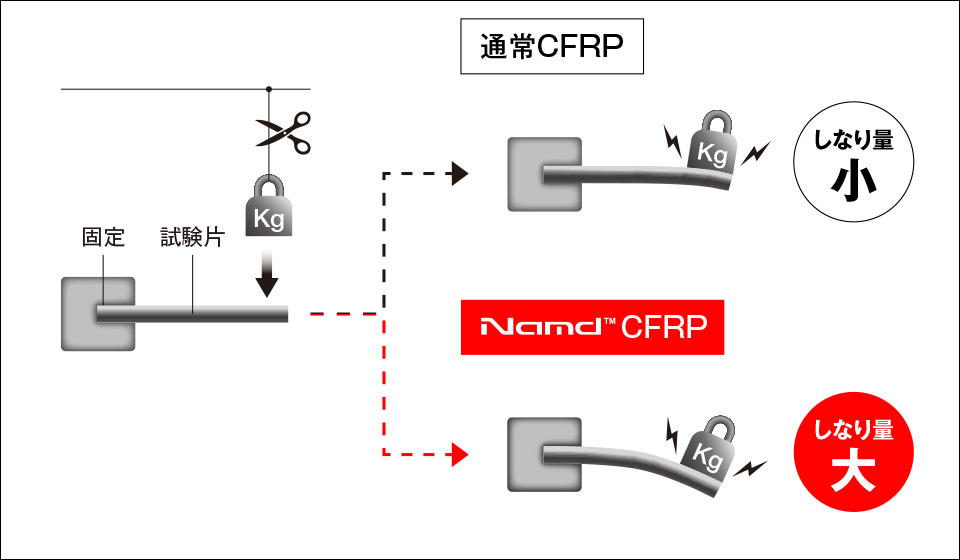
① Deflection (amount of bending)
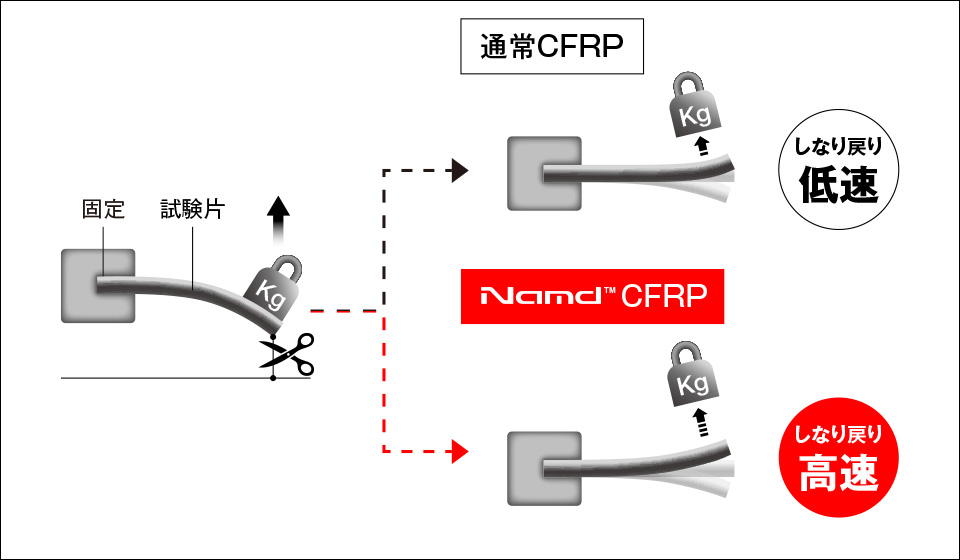
② Recovery speed of the deflection (spring-back)
Test pieces of “normal CFRP” and “Namd™ CFRP” with the same elastic modulus are prepared, one end is fixed, the other end is deflected by a set amount and held in that deflected position. A weight is then placed on the deflected end and the deflection is released. The restoring force of the test piece throws the weight upwards.
Comparing the height the weight jumps, you can observe that it is thrown higher with the “Namd™ CFRP” test piece.
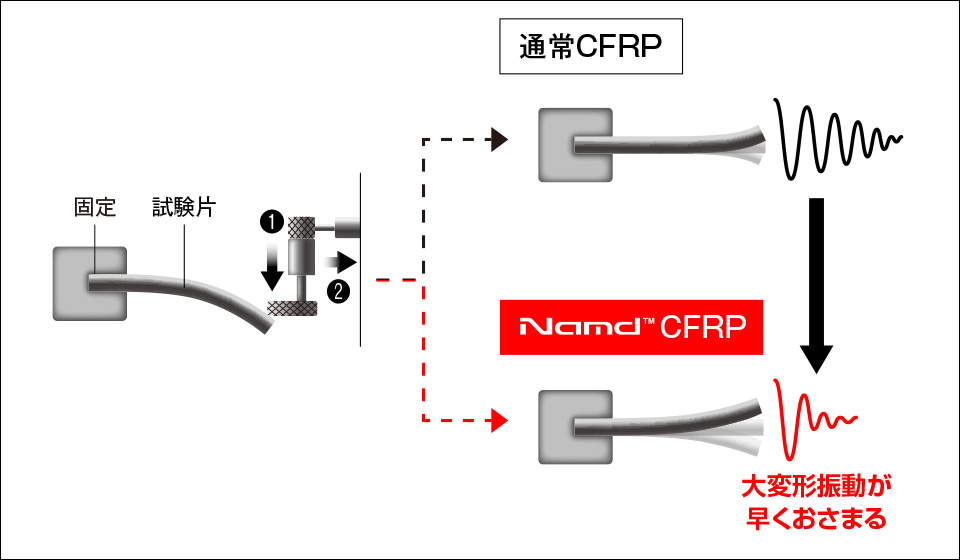
③ Vibration damping at large amplitude
Test pieces of “normal CFRP” and “Namd™ CFRP” with the same elastic modulus are prepared, one end is fixed and the other end is released from a position deflected by a set amount. A vibration can be observed; with “Namd™ CFRP”, however, the vibrations are seen to decay (be damped) faster.

④ Reinforcing effect of Namd™ on individual CF filaments
“Normal CF” can develop many fine surface defects during the manufacturing process and when compounded with resin. CF is a material with high tensile strength, but under tensile stress cracks propagate from these defects on the CF surface into the interior and eventually lead to breakage.
With “Namd™ CF”, on the other hand, a layer of CNT, whose tensile strength is higher than that of CF, is formed on the surface. This reduces the probability of breakage originating from surface defects.

Namd™ is a revolutionary carbon fibre, ideally suited for “golf shafts” and “fishing rods”!


OLYMPIC Sensitivity System
Whether the “sensitivity” (transmission of bites/vibrations) of a rod is good or bad could previously only be judged after the rod had actually been built. Moreover, perception differs from angler to angler, and there was no established evaluation method.
We developed numerous prototypes and repeatedly carried out sensitivity measurements and practical tests at the water in order to “quantify” sensitivity. In the end we succeeded in expressing “sensitivity” in numbers. This is how the “O.S.S.” (OLYMPIC Sensitivity System) came about.
With this system it is possible to offer rods that meet standardised values under equal conditions. The tests are carried out with the target fish species of each rod; here we present the test procedure using the rockfish rod “Finezza” as an example.
◆ The human hand can perceive frequencies
The Meissner corpuscles and Pacinian corpuscles under the skin can perceive frequencies (vibrations). These receptors are especially concentrated in the fingertips.
There are test results showing that in a frequency test from to could distinguish, in all frequency ranges, within a range of . Based on this report, experiments can be carried out assuming that the sensitivity of a rod can be perceived by humans as a frequency.
Note: The number and response behaviour of these corpuscles differ greatly from person to person.
◆ ◆ There are two types of bites (strikes) with Mebaru (Japanese rockfish)
We first decided to measure actual Mebaru bites. In this test we attached sensor units to a total of five rods: two rods from other manufacturers as well as the prototypes GOFS-762UL-S, GOFS-762UL-T G+ (with more guides) and GOFS-762UL-T G- (with fewer guides).
Using FFT analyzer (Fast Fourier Transform) and MeasuringAmp (accelerometer), we wanted to display the frequencies of the bites as a line chart on a PC.
As tackle we used a fluorocarbon line and a jig head. In this test we detected eight bites per rod, a total of bites. These could be roughly divided into two patterns:
- “Suck-in/turn-over type” (graph ①)
- “Chase/peck type” (graph ②)
Since the waveforms differ, it is evident that different frequencies arise in each case.


◆ Frequencies of the individual bite types
From the vibration/acceleration charts mentioned above, we calculated the frequencies of the bites transmitted to the rod. It turned out that the “suck-in/turn-over type” lies mainly in the frequency range of to . With the tubular rod from manufacturer A, the bite curve could only be seen once, representing the trace of a short bite.
It follows: with extremely small bites of this low frequency, it is less decisive to “feel” the bite and then actively strike; what matters more is how well the fish can be hooked automatically with a soft tip.
The second type, the “chase/peck type”, lay in the frequency range of to . In this range, clearly visible differences in the curves appeared depending on the rod. One can therefore say: what is decisive for a highly sensitive rod is how well it makes bites in this frequency range perceptible.
◆ Differences in natural frequency lead to differences in perception
When an object is given a shock/impulse, it vibrates at a certain frequency. This is called the natural frequency. In general: the harder a material, the higher the frequency; the softer, the lower.
Of course fishing rods also have a natural frequency. The measurement results are shown in table ③. To a fluorocarbon line a weight of size “No. ” was attached and the line was plucked with a finger; the average of measurements is shown.
It can clearly be seen that only the rod from manufacturer B has a natural frequency shifted strongly into the low-frequency range. It is assumed that these differences in the natural frequency of the respective rods are one of the reasons why bites “feel” different depending on the rod.

◆ Bites become clear when resonance occurs
There is the phenomenon of “resonance”. Resonance means that the amplitude is greatest when the natural frequency and the externally applied frequency match. In other words: when the frequency of the bite roughly corresponds to the natural frequency of the rod, a resonance state arises – and this feels “highly sensitive” to the angler.
Comparing the two bite frequency ranges with the natural-frequency chart ③ shows: the rod from manufacturer B has more difficulty perceiving the “chase/peck type”. The Finezza, on the other hand, can detect both bite types – with both tubular top and solid top – thanks to its own action tuning. Especially with the bites where the sensitivity differences show strongly, i.e. the “chase/peck type” in the range of to , the difference is clearly visible.
In conclusion, even with a solid top, depending on the action setting, a sensitivity can be achieved that is hardly inferior to a tubular top. We could not detect a sensitivity difference due to the number of guides on the Finezza in this experiment.
◆ The difference becomes even clearer when compared via the damping rate
In addition to the tests above, we also looked at the damping rate and its relationship to sensitivity. The damping rate describes how quickly and to what extent a vibration decays. If damping is high relative to the bite frequency, the vibration calms down very quickly even when a bite comes. This makes it harder to feel the vibration in the palm as a “signal”.
We used a vibration exciter and checked, for each rod, the damping rate relative to the measured “peck” bite (approx. ). The result matched the ranking we had previously drawn up from real-world feel. Since this can be expressed quite clearly in numbers, this method is to be regarded as an effective means of measuring sensitivity.


G-MAPS
In general, rod blanks are made by arranging carbon fibres at (lengthwise) and (crosswise) and – depending on the required power – laminating carbon sheets (prepreg) in several layers.
With Graphiteleader, by applying a further-developed manufacturing process called G-MAPS it has been possible to realise blanks with higher power and strength. The G-MAPS process uses extremely thin carbon prepreg and relies on a multilayer structure. In addition, in some layers the fibres are aligned at an angle to the longitudinal direction which also increases the torsional stiffness – a very advantageous approach in terms of materials.
So one can say: blanks made with the G-MAPS process are light and yet powerful – in other words high-tech blanks with properties that were hardly attainable with conventional standard processes. Combined with 4-axis braids or multiaxial fabrics, even a blank that can be called “ultimate” can be made.


Even when bending and twisting deform the cross-section of the tubular blank as shown in the illustration, the rod instantly tries to become straight again.
The G-MAPS process thanks to its outstanding shape-restoring force enables an unprecedented, supple, spring-like snap-back from the bend.
Note: The illustration is for explanatory purposes only.


Autoclave technology
The “autoclave process” is a special moulding process used to produce particularly important, safety-relevant components – for example for the wings of the Boeing 787 or body parts of racing cars.
In contrast to conventional curing and moulding processes, a special curing oven (autoclave) is used. During heating, degassing and a vacuum are applied and then pressure is additionally built up. This removes air inclusions (voids) between the layers of the carbon sheets (prepreg laminates) as far as possible – an innovative moulding process.
As a result, one expects higher quality, greater material purity and a more stable, more uniform strength – and, as a consequence, also the potential for further weight reduction.


http://www.carbonmagic.com/
This revolutionary moulding process, the “autoclave technology”, was realised in cooperation with Toray Carbon Magic Co., Ltd. Toray Carbon Magic is a subsidiary of our main carbon material supplier, the industry-leading Toray Industries, Inc.
Powerded by Mickeys Tackle